
Waihonua Shower Glass Restoration Case Study
How Renue Hawaii Restored Cloudy Shower Glass at Waihonua After Three Previous Companies Could Not
Shower glass restoration is often requested only after routine cleaning and previous restoration attempts have failed to produce an acceptable result. This case study documents how Renue Hawaii restored a representative shower-glass panel at Waihonua in Honolulu after three previous companies were unable to remove the cloudy appearance caused by bonded mineral deposits, soap residue, and hard-water buildup.
The property is professionally managed by Jack Tyrrell & Company, Inc., which requested another evaluation before assuming the shower glass required replacement. Rather than making immediate promises, Renue Hawaii began with a representative test panel to determine whether the cloudiness was recoverable surface contamination or permanent damage within the glass itself.
The completed test demonstrated that much of the visible cloudiness was caused by removable buildup rather than irreversible deterioration. By restoring a representative section first, management was able to evaluate the achievable result before making decisions about a larger restoration scope.
The Challenge
The Shower Glass Remained Cloudy After Three Previous Restoration Attempts
By the time Renue Hawaii was asked to evaluate the shower glass at Waihonua, the property had already invested time and money trying to correct the condition. Three previous companies had attempted to remove the cloudy appearance, hard-water spotting, and soap scum buildup, yet the glass continued to look heavily contaminated.
When multiple restoration attempts fail, it becomes difficult to determine whether the remaining cloudiness is caused by recoverable surface deposits or permanent damage within the glass itself. At that point, many properties begin considering replacement because they no longer know whether restoration is still a realistic option.
Rather than assuming the glass could or could not be restored, Renue Hawaii approached the project as a technical evaluation instead of another cleaning attempt. The objective was to determine whether the visible condition was primarily caused by removable buildup or whether the glass had reached the point where replacement would become the more appropriate investment.
The Property Needed Answers to Four Questions
Was the Cloudiness Recoverable?
Determine whether the visible haze was primarily removable contamination or permanent damage.
Could Restoration Produce an Acceptable Result?
Establish whether restoration could justify expanding the project across additional shower enclosures.
Why Had Previous Attempts Fallen Short?
Evaluate whether bonded deposits remained that required a different restoration approach.
Should the Glass Be Restored or Replaced?
Provide evidence before management committed to the cost of replacement.
Questions like these are common when evaluating cloudy shower glass . Before replacement is considered, it is often worthwhile to determine whether the condition is caused by recoverable hard-water deposits and bonded surface buildup that can still be professionally restored.
Multiple unsuccessful attempts do not automatically mean the glass cannot be restored. They simply mean the cause of the remaining cloudiness has not yet been accurately identified.
Why Previous Attempts May Have Fallen Short
Cloudy Shower Glass Can Contain Several Layers That Do Not Respond to One Standard Process
Shower glass can remain cloudy even after professional cleaning because the visible condition may be made up of several different layers. Hard-water minerals, soap residue, body oils, silicone-containing products, cleaning-product residue, and older contamination can overlap across the same panel.
A process may successfully remove one layer while leaving another behind. The glass can therefore look somewhat improved but still fail to reach the clarity the property expects.
Repeating the same chemistry or increasing scrubbing pressure does not necessarily solve that problem. It may only continue working on the layer that has already been reduced while the more strongly bonded contamination remains.
Heavy buildup can also hide the physical condition of the glass underneath. Fine scratches, permanent haze, previous treatment marks, or surface alteration may not become fully visible until the recoverable deposits have been removed and the panel has dried.
Renue Hawaii did not assume exactly why the earlier attempts had failed. Instead, the glass was evaluated as a layered restoration problem so the remaining contamination and the true condition underneath it could be separated through controlled testing.
Learn more about the differences between cloudy shower glass caused by surface buildup , bonded hard-water mineral deposits , and permanent conditions that may justify replacement .
A panel can remain cloudy after one layer has been removed because the visible problem may be several restoration problems stacked together.
Why One Standard Cleaning Process May Not Be Enough
Minerals Bond to the Surface
Repeated water evaporation leaves concentrated mineral deposits that routine glass cleaner may not dissolve.
Soap and Oils Create Another Layer
Soap residue, body oils, and personal-care products can form a film over or between the mineral deposits.
Cleaning Products Can Leave Residue
Excess product, incomplete rinsing, and incompatible chemistry can add smearing, haze, or additional buildup.
Prior Attempts Change the Surface
Earlier chemistry, pads, blades, coatings, or treatments may affect how the remaining condition responds.
Permanent Damage May Be Underneath
Scratches, surface alteration, or permanent haze become easier to evaluate only after recoverable deposits are removed.
The objective was not to repeat another cleaning attempt. It was to identify and remove each recoverable layer until the true condition of the Waihonua glass could be evaluated.
Renue’s Representative Test
Renue Tested a Representative Area Before Recommending a Larger Scope
After three previous companies had been unable to produce the required result, Renue Hawaii did not begin by treating every panel or promising a full-property outcome.
The first step was to select a representative section of the shower glass and test whether the visible cloudiness was primarily caused by recoverable buildup or permanent damage.
The restoration process was controlled around the condition of the glass. Chemistry, dwell time, agitation, rinsing, detailing, and protection of nearby finishes were adjusted to remove the bonded contamination without assuming every visible mark would respond the same way.
Once the test area had been restored, the glass was allowed to dry fully. This mattered because wet glass can temporarily appear clearer and conceal remaining haze, residue, scratching, or surface alteration.
The dried test result gave Jack Tyrrell & Company, Inc. direct evidence of the improvement Renue could produce before any larger restoration scope was considered.
This test-first approach is also central to Renue Hawaii’s condo shower-glass restoration and maintenance programs because it allows management to establish realistic expectations before work is expanded across additional units.
The test was designed to answer one question: was the cloudiness removable buildup or permanent damage?
How Renue Established Whether the Glass Was Still Recoverable
Inspect
Evaluate the cloudiness, spotting, residue, surrounding finishes, prior treatment history, and visible damage.
Select
Choose a representative section that fairly reflected the condition without exposing the entire enclosure.
Restore
Apply a controlled process designed to remove recoverable minerals, soap scum, and layered buildup.
Dry and Evaluate
Inspect the fully dried glass to separate restored clarity from permanent haze, scratching, or other limitations.
Decide
Determine whether the result justified expanding restoration instead of moving directly toward replacement.
Renue did not ask management to trust a promise. The representative test made the achievable result visible before the next decision was made.
Before-and-After Evidence
The Test Revealed That the Cloudiness Was Primarily Recoverable Buildup
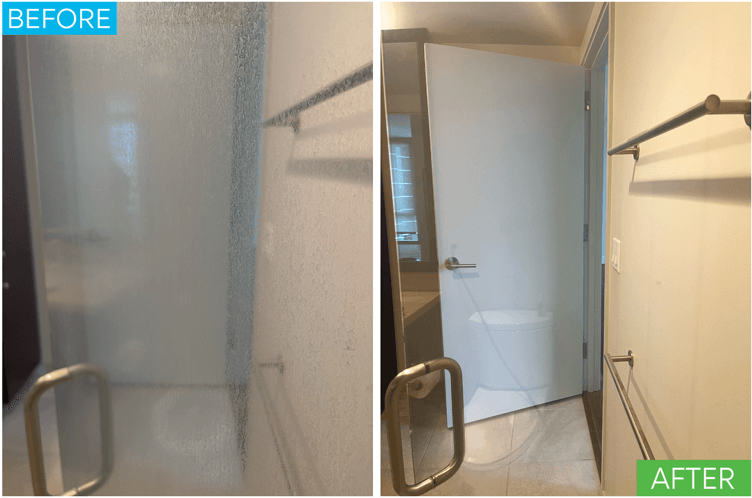
The representative test panel produced the evidence management needed. The untreated section remained visibly cloudy with water spotting, soap residue, and bonded surface buildup. The restored section showed a substantial improvement in clarity.
This result demonstrated that the shower glass still had meaningful restoration value despite three earlier attempts that had not produced the required outcome.

Before Restoration
Cloudiness Obscured the True Condition
Water spots, soap scum, mineral deposits, and layered contamination reduced clarity across the panel and made it difficult to determine whether the glass itself was permanently damaged.
After Restoration
The Glass Recovered Significant Clarity
The controlled restoration removed recoverable surface deposits and exposed a substantially clearer panel that could be evaluated on its actual condition rather than the contamination covering it.
What the Representative Result Proved
The Buildup Was Recoverable
A meaningful portion of the visible haze came from bonded deposits rather than irreversible damage.
The Glass Still Had Service Value
Previous unsuccessful attempts had not established that the panel needed to be replaced.
The Correct Process Mattered
Condition-specific restoration produced a result that another general cleaning attempt had not achieved.
The Dry Result Could Be Evaluated
Once the buildup was removed, management could judge the clarity and any permanent limitations more accurately.
A Larger Scope Could Be Defended
The visible improvement created evidence for deciding whether restoration should expand beyond the test area.
The before-and-after result changed the conversation from “Has this glass failed?” to “How much of this condition can now be responsibly restored?”
Similar conditions may still be recoverable when cloudy shower glass is primarily caused by bonded hard-water minerals and layered surface buildup . The correct decision should be based on a representative dry result before the property moves toward restoration or replacement .
Three previous failures created uncertainty. One controlled test created evidence.
The Result
The Successful Test Changed the Decision From Assumption to Evidence
Before Renue Hawaii completed the representative test, management had limited evidence that the shower glass could still be restored. Three previous companies had already attempted the work, and the remaining cloudiness made replacement appear increasingly likely.
The restored test area changed that position. Recoverable hard-water deposits, soap scum, and bonded buildup were removed, producing a substantial improvement in clarity and revealing that the glass still had meaningful service value.
The result also made the remaining condition easier to judge. Once the recoverable buildup was removed and the panel had dried fully, management could distinguish restored clarity from any permanent scratches, haze, or surface limitations underneath.
This gave Jack Tyrrell & Company, Inc. a defensible basis for the next decision. The property no longer had to assume that prior unsuccessful attempts meant the glass required replacement. It could evaluate whether restoration should expand based on visible evidence.
Renue did not promise that every shower-glass panel would become new or respond identically. The representative test proved that this condition could achieve an improvement strong enough to justify restoration rather than defaulting immediately to replacement.
For properties making the same decision, Renue Hawaii recommends comparing the representative dry result through the Shower Glass Restoration vs Replacement guide before committing to a larger capital scope.
The test did not create another opinion. It created evidence that the glass was still worth restoring.
How the Representative Test Changed the Property’s Position
Before the Test
Restoration Appeared Uncertain
Three unsuccessful attempts made it difficult to know whether the remaining cloudiness was removable or permanent.
After the Test
Recoverable Buildup Was Proven
The restored section showed that bonded deposits were still covering glass with substantial remaining clarity.
Decision Value
Replacement Was No Longer the Default
Management could compare restoration and replacement using the actual dry result rather than the history of failed attempts.
Operational Value
The Scope Could Be Tested Before Expansion
Additional work could be considered only after the representative result established the achievable standard.
Long-Term Value
The Restored Glass Could Be Protected
Once approved, the glass could be evaluated for hydrophobic protection and a clearer maintenance process.
Renue did not promise that every panel would become new. The test proved that this glass could achieve a result strong enough to justify restoration.
Why the Result Was Different
The Difference Was Not a Stronger Cleaner. It Was a Controlled Restoration Process
After several unsuccessful attempts, the easiest explanation would have been that the glass simply needed a stronger product. That was not the issue.
Shower glass can remain cloudy because the visible condition is made up of several layers that respond differently. Hard-water minerals, soap residue, body oils, silicone-containing products, housekeeping chemistry, and older contamination may all require different levels of correction.
Renue Hawaii approached the Waihonua glass as a restoration problem rather than repeating another general cleaning process. The work began with diagnosis, representative testing, and a controlled sequence designed around how the actual surface responded.
Chemistry, dwell time, agitation, rinsing, detailing, and dry-result evaluation were treated as parts of one process. Each step was adjusted to remove recoverable buildup without assuming that every remaining mark was contamination or that more aggressive treatment would automatically produce a better result.
The surrounding finishes also remained part of the decision. A successful glass result would not have been defensible if the process created damage, residue, spotting, or inconsistency on nearby tile, grout, metal, sealants, or other enclosure surfaces.
Most importantly, the larger scope was not recommended until the test area had dried and the result could be judged clearly. That separated visible improvement from sales language and gave management a result it could actually approve.
This same test-first standard is central to Renue Hawaii’s professional shower-glass restoration process and coordinated condo shower-glass programs .
The breakthrough came from treating the glass as a restoration problem, not repeating another cleaning attempt.
Five Controls That Turned Another Attempt Into a Defensible Restoration
Diagnose Before Escalating
Determine what type of buildup remains before increasing chemistry, abrasion, pressure, or dwell time.
Match the Process to the Condition
Adjust the restoration method to the glass response rather than forcing one standard process across the panel.
Control the Full Enclosure
Protect nearby tile, grout, metal, sealants, and surrounding finishes from chemistry, runoff, and residue.
Judge the Dry Result
Allow the glass to dry fully so restored clarity, permanent haze, scratches, and limitations can be evaluated honestly.
Let the Test Earn the Scope
Expand restoration only after the representative result proves the work is technically and financially defensible.
Waihonua did not need another company willing to try. It needed a process capable of proving what the glass could still become.
What Property Managers and AOAOs Can Learn
Failed Cleaning Attempts Do Not Automatically Mean the Glass Must Be Replaced
The Waihonua result illustrates an important decision point for condominium associations, resident managers, property managers, and building owners. Several unsuccessful attempts can make replacement feel like the only remaining option, but those attempts do not establish whether the visible condition is recoverable.
Before budgeting for new glass, the property should test a representative panel and inspect the result after it has dried fully. That separates bonded mineral deposits, soap residue, body oils, and cleaning-product buildup from permanent scratching, haze, edge damage, or surface alteration.
Representative testing also protects the property from approving a broad scope based on assumptions. Management can define the acceptable result first, identify the process required, and determine whether similar panels should be restored, protected, monitored, referred, or replaced.
For larger condominium properties, the test can become the foundation of a coordinated program. Units may be grouped by condition, floor, stack, tower, enclosure type, or access window instead of forcing every shower into the same recommendation.
Once restoration is approved, the property should also decide how the result will be protected. Hydrophobic coating, compatible housekeeping products, non-abrasive tools, practical water removal, and one clear maintenance standard can reduce the chance of the glass returning quickly to the same bonded condition.
The strongest building program does not promise that every panel will become new. It creates a repeatable process for testing, classifying, restoring, protecting, documenting, and replacing only where the evidence supports it.
Property managers and AOAOs evaluating similar conditions can review Renue Hawaii’s Condo Shower Glass Restoration, Coating & Maintenance Programs , Shower Glass Restoration vs Replacement , and Hydrophobic Shower Glass Coating Hawaii guides before approving a larger project.
The building should not standardize one outcome. It should standardize how every restoration decision is tested and approved.
A More Defensible Building-Level Decision Process
Test Before Budgeting
Establish whether the condition is recoverable before placing full replacement into the capital plan.
Classify the Glass
Separate panels into restore, restore and protect, restore with limitations, specialist review, or replace.
Phase the Work
Organize approved restoration by unit, floor, stack, tower, condition group, or available access window.
Protect the Result
Apply hydrophobic protection where appropriate and establish compatible housekeeping and resident care.
Document the Standard
Record tested results, accepted limitations, completed work, deferred units, and future service triggers.
Waihonua demonstrates that the right first investment is not always restoration or replacement. Sometimes it is the representative test that determines which investment can actually be defended.
Shower Glass Restoration Assessment
Have Other Companies Tried Without Producing a Defensible Result?
An unsuccessful cleaning or restoration attempt does not automatically prove that cloudy shower glass must be replaced. It may mean the remaining condition has not yet been properly diagnosed, tested, or separated into recoverable buildup and permanent damage.
Renue Hawaii can inspect the glass and surrounding finishes, complete a controlled representative test area, evaluate the fully dried result, and determine whether a larger restoration scope is technically and financially defensible.
The assessment can help property managers, condominium associations, hotels, homeowners, and facility leaders compare restoration, restoration with documented limitations, hydrophobic protection, selective replacement, or complete replacement using visible evidence instead of assumption.
Where the test proves the glass still has restoration value, Renue can help define the achievable standard, protect surrounding finishes, structure the larger scope, and establish a compatible maintenance process afterward.
Three failed attempts did not prove the Waihonua glass was beyond restoration. They proved the condition had not yet received the right process.
Waihonua Case Study FAQ
Common Questions About Failed Shower Glass Cleaning Attempts, Representative Testing, and Restoration
These answers apply to property managers, AOAOs, hotels, homeowners, and facility leaders evaluating cloudy shower glass after routine cleaning or previous restoration attempts have failed.
1. Can shower glass still be restored after other companies have tried?
Yes. Previous attempts may have removed only part of the condition or used a process that did not address every layer of bonded contamination.
A representative test can determine whether recoverable buildup remains and whether the achievable dry result justifies additional restoration.
2. Why can shower glass remain cloudy after professional cleaning?
The visible cloudiness may include several overlapping layers, such as hard-water minerals, soap residue, body oils, silicone-containing products, cleaning-product buildup, prior treatment residue, scratching, or permanent surface alteration.
3. Did Renue determine exactly why the previous Waihonua attempts failed?
Renue did not make assumptions about the methods used by the previous companies. The glass was evaluated based on the remaining condition and how it responded during controlled representative testing.
4. What does a representative shower glass test show?
The test helps establish how much of the cloudiness is recoverable, what process is required, what permanent limitations remain, how the surrounding finishes should be protected, and whether a larger restoration scope is defensible.
5. Why must the glass be inspected after it dries?
Wet glass can temporarily appear clearer and hide haze, residue, fine scratches, failed coatings, or permanent surface alteration. The fully dried result shows the condition the property will actually see and maintain.
6. Can hard-water minerals and soap scum require different restoration steps?
Yes. Mineral deposits, soap residue, oils, silicone-containing products, and cleaning-product buildup can respond differently to chemistry, dwell time, agitation, rinsing, and detailing.
7. Does a successful restoration test mean the glass will look new?
No. Restoration removes recoverable buildup. Permanent scratches, haze, edge damage, failed films, chips, cracks, or prior treatment marks may remain after the glass has been restored.
8. When is shower glass replacement still the better decision?
Replacement may be more defensible when the fully dried test result reveals permanent damage or when the restored appearance cannot meet the property’s approved standard.
9. Can Renue test one condo unit before proposing a building-wide program?
Yes. Representative units or panels can be selected to reflect the meaningful range of conditions before restoration is expanded by unit, floor, stack, tower, or condition group.
10. Can the restored glass receive hydrophobic protection?
It may be appropriate after the glass has been restored, inspected while fully dry, accepted by the property, and properly prepared for professional hydrophobic coating.
11. Does hydrophobic coating prevent all future water spots?
No. Hydrophobic protection can help water release more readily and reduce adhesion, but the glass still requires compatible products, non-abrasive tools, water removal, residue cleaning, and periodic inspection.
12. How should restored shower glass be maintained?
Use approved chemistry, correct dilution, non-abrasive microfiber, clean squeegees, thorough rinsing, practical drying, and professional assessment when routine care stops producing the expected result.
13. Should stronger chemistry or heavier abrasion be used when the glass stays cloudy?
Not automatically. Escalating chemistry, pressure, dwell time, or abrasion without identifying the remaining condition can damage the glass, coatings, hardware, sealants, stone, tile, grout, or nearby finishes.
14. Can restoration be phased instead of completed all at once?
Yes. Approved work can be phased by unit, floor, stack, tower, enclosure type, condition group, or access window after representative testing establishes the expected result.
15. What information should a property provide before requesting a test?
Provide photographs, panel or unit counts, prior attempts, current cleaning products, known coatings or treatments, surrounding finishes, visible scratches or damage, access conditions, and whether replacement is being considered.
Unsure whether cloudy shower glass is recoverable? Request a representative shower glass test from Renue Hawaii.