
Commercial Carpet Problems & Diagnosis Hawaii
The First Question Is Not How to Clean the Carpet. It Is What Changed.
Commercial carpet that appears dark, flat, stained, uneven, sticky, odorous, or prematurely worn should be diagnosed before additional cleaning, repair, or replacement is approved. Similar-looking symptoms can have very different causes, and the wrong response can waste money, conceal the actual problem, or make the condition more difficult to correct.
Recoverable soil, detergent residue, pile distortion, abrasion, color loss, moisture, backing failure, adhesive problems, installation conditions, and end-of-life wear may look similar from standing height. They do not require the same solution. One condition may respond to restorative cleaning, while another may require dye repair, moisture evaluation, installer review, selective replacement, or no further cleaning at all.
Renue Hawaii evaluates the carpet as a system. The assessment may include the visible condition, carpet construction, traffic patterns, maintenance history, chemistry previously used, drying conditions, installation details, and manufacturer care requirements. A representative test area can then help separate removable contamination from permanent wear, color change, or structural failure.
Where useful, carpet fibers may be examined under 40× magnification to help distinguish attached soil, residue, abrasion, distorted pile, damaged fiber tips, and color loss. Maintenance records, warranty requirements, and site conditions may also indicate whether the issue should be addressed by Renue, the flooring contractor, a moisture specialist, the supplier, or the manufacturer.
Do not approve the next expense until the carpet condition has been correctly classified.
Renue Commercial Carpet Decision Tree™
What Is Your Commercial Carpet Telling You?
A carpet that looks dirty may actually be holding residue, showing fiber abrasion, experiencing color loss, affected by moisture, or developing a backing, adhesive, or installation problem. Use this diagnostic framework to identify the correct first step before approving more cleaning, repair, warranty review, or replacement.
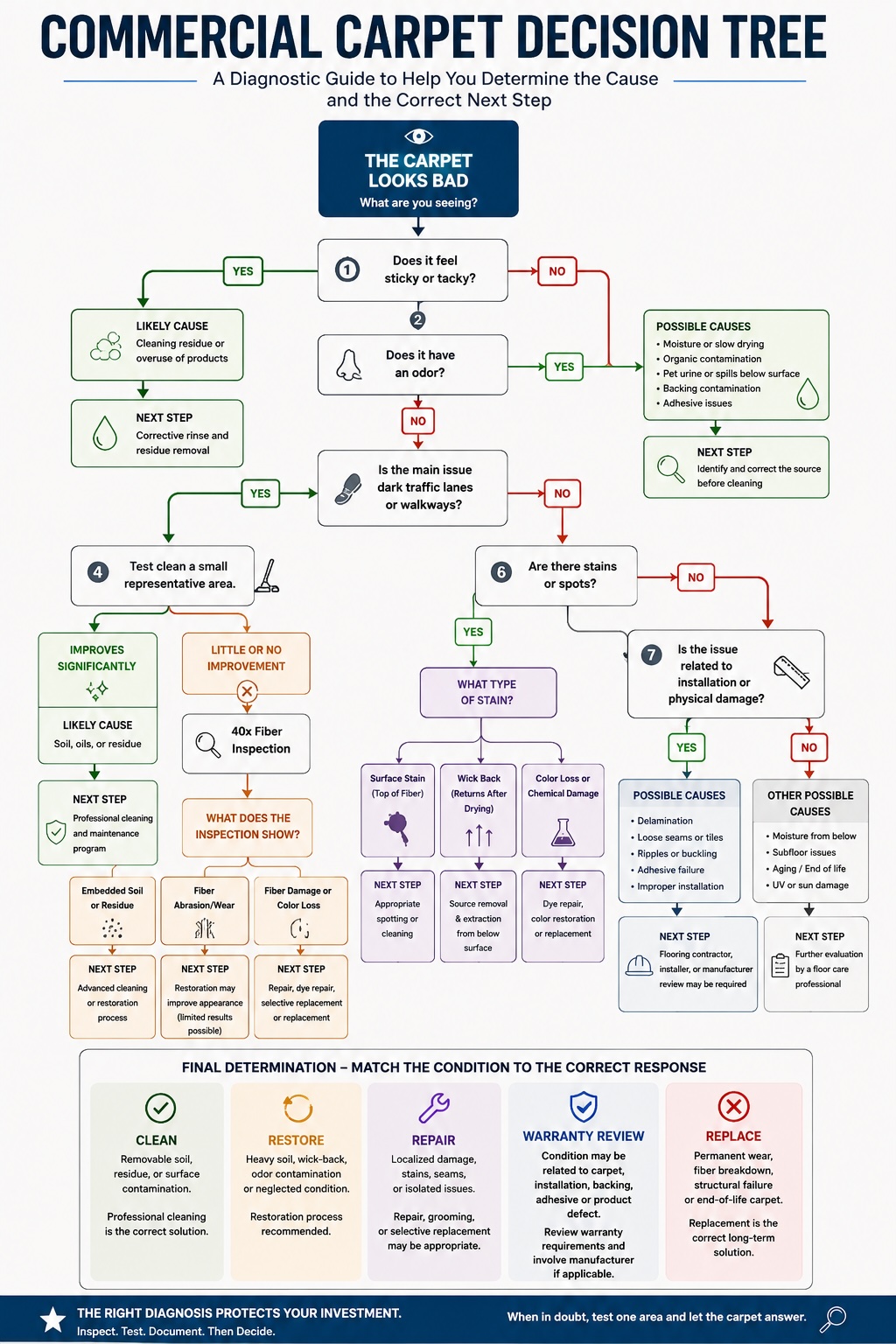
Sharing or referencing this resource? Please credit the Renue Commercial Carpet Decision Tree™ and link directly to: renuehawaii.com/commercial-carpet-problems-diagnosis-hawaii/
Do not judge commercial carpet from standing height alone. Inspect the fiber, verify the maintenance history, test a representative area, and let the carpet determine the correct response.
Why Carpet Problems Are Misdiagnosed
Commercial Carpet Can Look Dirty for Reasons Cleaning Cannot Correct
Commercial carpet is often judged from standing height, under changing light, after years of traffic, spot treatment, vacuuming, moisture exposure, and repeated maintenance. That makes different problems appear deceptively similar.
A dark traffic lane may be holding removable soil, but it may also be showing abrasion, pile distortion, residue, or color loss. A flattened area may look permanently crushed when oils and embedded soil are binding the fibers together. A recurring spot may appear to be a surface stain when the source is below the visible face fiber.
The same misdiagnosis happens with odor, discoloration, loose carpet tile, rippling, and uneven appearance. What looks like a cleaning issue may actually involve the backing, adhesive, slab, installation, moisture, or manufacturer performance.
More cleaning is not a neutral decision. Repeated chemistry, aggressive agitation, excess moisture, or the wrong process can add residue, alter color, slow drying, or complicate a condition that should have been escalated to the installer, flooring supplier, moisture specialist, or manufacturer.
The correct process is to separate appearance from cause. That means inspecting the fiber, reviewing the maintenance history, identifying the exact carpet product, and testing a representative area before deciding what the property should spend next.
The visible symptom tells you where to look. It does not always tell you what the problem is.
The Renue Diagnostic Process
Renue Does Not Judge Commercial Carpet From Standing Height Alone
Commercial carpet can look dirty, crushed, faded, uneven, or permanently worn before the actual cause is understood. Renue Hawaii uses a diagnostic process designed to separate appearance from condition before recommending cleaning, restoration, repair, warranty review, or replacement.
The process begins with the visible symptoms, but it does not end there. Renue can inspect the affected traffic zones, compare conditions across the installation, identify the exact carpet product where possible, and review how the carpet has been vacuumed, spot-treated, professionally cleaned, and documented.
Where useful, Renue can examine carpet fibers under 40× magnification. This can help reveal whether the fiber is coated with attached soil or residue, physically abraded, distorted, damaged at the tips, or showing actual color loss.
A representative test area can then show what the correct cleaning process removes and what remains. The post-cleaning result helps separate recoverable contamination from permanent wear, pile distortion, chemical damage, moisture-related concerns, or structural failure.
Renue can also review the applicable manufacturer care requirements and available maintenance records. When the property has followed the required carpet-care program, some premature performance, backing, adhesive, installation, or product concerns may warrant supplier, installer, or manufacturer review.
The objective is not to prove that the carpet needs cleaning. It is to identify the condition accurately and recommend the response that best protects the property.
What Cleaning Can Correct
Professional Cleaning Is the Correct Response When the Problem Is Recoverable Contamination
Commercial carpet should be professionally cleaned when the visible decline is being caused by recoverable soil, oils, residue, spills, or contamination held within the face fiber or upper carpet structure.
In Hawaii properties, that contamination often includes sand, fine abrasive soil, food and beverage residue, body oils, tracked-in moisture, luggage traffic, repeated spot-treatment chemistry, and buildup that routine vacuuming cannot fully remove.
The correct process depends on the exact carpet, soil load, backing, traffic, moisture tolerance, drying conditions, and manufacturer guidance. Manufacturer-approved counter-rotating low-moisture cleaning can provide strong agitation with reduced moisture and faster drying in many low-pile commercial areas. Hot water extraction is more appropriate when heavier soil, residue, spills, odor contamination, or deeper rinsing is required.
Cleaning can also correct many dark traffic lanes when the appearance change is primarily soil, oils, or residue rather than permanent abrasion. The result should be confirmed through a representative test area rather than assumed from appearance alone.
Recurring spots and wick-back can also be addressed when the contamination source is identified and the process reaches below the visible surface. Repeated surface spotting is not enough when the spill or residue remains in the backing or lower carpet structure.
When the problem is contamination, professional cleaning removes the cause instead of covering the symptom.
What Cleaning Cannot Correct
Cleaning Removes Contamination. It Does Not Rebuild Damaged Carpet.
Professional cleaning can remove soil, oils, residue, spills, and recoverable contamination. It cannot rebuild fibers that have been physically worn away, restore missing dye, repair failed backing, reactivate damaged adhesive, or correct an installation defect.
This distinction matters because permanent damage can resemble dirt. A dark traffic lane may remain after cleaning because the fiber surface has been abraded. A light or orange area may be chemical color loss rather than a stain. A flattened section may be permanently distorted, while rippling, loose tiles, seam separation, or delamination point to structural concerns rather than soil.
Additional chemistry or repeated cleaning does not improve these conditions. It may add moisture, residue, agitation, or delay to a problem that should instead be repaired, reviewed by the flooring installer, evaluated for moisture, submitted for manufacturer review, selectively replaced, or fully replaced.
Renue Hawaii separates cleanable contamination from permanent fiber, color, backing, adhesive, and installation damage through inspection, maintenance-record review, 40× magnification where useful, and representative testing.
When cleaning is not the answer, the property should receive a clear explanation of what remains, why it remains, and which party or corrective path should be considered next.
Knowing when not to clean protects the property from repeated spending without a realistic restoration outcome.
Dirty, Crushed, or Worn?
Carpet That Appears Crushed May Actually Be Holding Embedded Soil
Commercial carpet can appear flat, gray, dull, or permanently crushed when the fibers are actually coated with fine soil, oils, residue, and tracked-in contamination. That buildup changes how the pile separates, moves, and reflects light, making recoverable contamination look like permanent wear.
This is especially common in hotel corridors, condo hallways, elevator landings, luggage routes, entries, and other high-traffic areas. Repeated foot traffic can press contaminated fibers together until the carpet looks matted or worn from standing height.
Visual inspection alone cannot always separate soil from actual fiber damage. Where useful, Renue Hawaii can examine the carpet under 40× magnification to look for attached soil, residue, damaged fiber tips, abrasion, distortion, and color loss.
A representative test cleaning should follow the inspection. If the correct process releases the fibers, improves color, and restores more even light reflection, the condition was at least partly contamination. If the carpet remains visibly distorted after the soil is removed, permanent abrasion, pile damage, or end-of-life wear may be present.
This distinction matters before ownership approves replacement. Carpet that appears crushed may still be restorable. Carpet with permanent fiber damage may need repair, selective replacement, warranty review, or full replacement instead of additional cleaning.
Do not call the carpet worn until the soil has been removed and the fiber has been inspected.
Match the Condition to the Correct Response
Cleaning, Restoration, Repair, Warranty Review, or Replacement?
Once the condition has been identified, the property should stop treating every carpet problem as the same expense. The correct response depends on whether the carpet is contaminated, neglected, locally damaged, structurally compromised, potentially warrantable, or at the end of its useful life.
A clear diagnosis protects the property in both directions. It prevents premature replacement when the carpet can still be restored, and it prevents repeated cleaning when permanent damage, moisture, installation, backing, or adhesive problems require a different solution.
Clean
Cleaning is the correct response when the problem is recoverable contamination held within the carpet fiber or upper structure.
- Dry soil and sand
- Tracked-in oils
- Surface spills
- Cleaning residue
- Sticky carpet
- Traffic-lane contamination
Restore
Restoration is appropriate when the carpet is structurally sound but requires a more corrective process than routine maintenance.
- Heavy embedded buildup
- Recurring spots
- Wick-back
- Neglected appearance
- Recoverable odor contamination
- Residue requiring deeper rinsing
Repair
Repair is the correct direction when the problem is localized and the surrounding carpet remains serviceable.
- Localized color loss
- Carpet dye repair
- Isolated stains
- Seam concerns
- Selected carpet tiles
- Small damaged sections
Review or Escalate
Some conditions should move beyond cleaning and into flooring, moisture, installer, supplier, or manufacturer review.
- Backing separation
- Adhesive failure
- Loose carpet tiles
- Rippling or dimensional change
- Active moisture
- Possible warranty concerns
Replace
Replacement is appropriate when the carpet no longer has a realistic cleaning, restoration, repair, or warranty path.
- Permanent fiber loss
- Widespread abrasion
- Severe structural damage
- Extensive chemical damage
- Failed backing or installation
- Normal end-of-life condition
The Correct Category Should Be Confirmed, Not Assumed
A representative test area, fiber inspection, maintenance-record review, and post-cleaning comparison can help determine which category applies. The result should be documented clearly enough for operations, ownership, the board, the installer, or the manufacturer to understand the next step.
When more than one condition exists, the solution may also be combined. A property may professionally clean most of the installation, dye repair selected areas, replace a limited number of tiles, and escalate a separate moisture or warranty concern.
Warranty and Documentation
Before Ownership Pays for Repair or Replacement, Determine Whether the Condition Warrants Manufacturer Review
Some commercial carpet conditions should not move directly from complaint to repair or replacement. Premature appearance loss, backing separation, adhesive concerns, dimensional change, delamination, installation problems, or performance that appears inconsistent with the product expectations may warrant review by the flooring supplier, installer, or manufacturer.
The first step is identifying the exact carpet product and reviewing the controlling warranty and maintenance documents. Brand name alone is not enough. Coverage, exclusions, care requirements, approved cleaning methods, vacuuming expectations, moisture limitations, documentation standards, and claim procedures can vary by collection, fiber, backing, adhesive, and installation system.
Maintenance history matters. If the property has followed the applicable carpet-care requirements, retained professional cleaning records, used appropriate methods, and documented the condition, that information can help demonstrate how the carpet was maintained before the concern developed.
Renue Hawaii can help organize the maintenance side of the review by documenting visible symptoms, inspecting the carpet fiber, reviewing available service records, performing a representative test where appropriate, and separating recoverable contamination from possible product, backing, adhesive, installation, or moisture-related concerns.
Renue does not determine warranty coverage. The manufacturer or responsible warranty party makes that decision. The purpose of the diagnostic review is to help the property understand whether the condition should be cleaned, repaired, escalated, or formally submitted for warranty consideration before ownership approves another expense.
Documentation does not guarantee warranty coverage, but without documentation the property may be unable to demonstrate that the required care was performed.
A Strong Warranty Review Follows a Clear Sequence
Identify
Confirm the exact product, backing, adhesive, installer, and warranty.
Document
Record the symptoms, affected areas, timeline, and maintenance history.
Test
Determine whether correct cleaning removes the condition or reveals permanent damage.
Separate
Distinguish contamination from product, installation, backing, adhesive, or moisture concerns.
Escalate
Submit the appropriate findings to the supplier, installer, manufacturer, or warranty party.
Properties should also review Renue Hawaii’s Commercial Carpet Warranty & Maintenance Programs Hawaii guide for additional planning around maintenance requirements, service records, and warranty protection.
What Not to Do
Do Not Keep Applying Chemistry Until the Problem Is Identified
When commercial carpet looks bad, the fastest response is often another spot treatment, stronger chemistry, more agitation, or another cleaning. That reaction can make the original problem harder to diagnose and more expensive to correct.
Repeated chemical applications can leave residue, attract more soil, alter color, damage fibers, or create a visible contrast between the treated area and the surrounding carpet. Additional moisture can also complicate wick-back, backing, adhesive, odor, and drying concerns.
Dark traffic lanes should not automatically be treated as removable soil. Apparent crushing should not automatically be classified as permanent wear. Odor should not be covered with deodorizer before the source is identified. Loose carpet tile, rippling, seam separation, and delamination should not be approached as routine cleaning problems.
The same discipline applies to replacement. Ownership should not approve a large capital expense before a representative area has been inspected and tested, particularly when contamination, residue, color loss, localized damage, or a potential warranty concern may be involved.
The safest operating rule is to stop adding variables. Document the symptom, preserve the maintenance records, identify the exact carpet, inspect the fiber, and test the correct process before taking the next action.
When the cause is unknown, more chemistry is not a solution. It is another variable.
What the Property Should Do Instead
Stop
Pause repeated spot treatment, cleaning, or chemical application in the affected area.
Document
Photograph the symptom, affected location, timeline, and any visible change after drying.
Verify
Identify the carpet product, maintenance guide, warranty, and previous products or methods used.
Inspect
Evaluate the fiber, pile, backing, adhesive, moisture, and installation where relevant.
Test
Use the correct process on one representative area before expanding the scope.
Diagnosis should come before escalation, additional cleaning, warranty submission, or replacement.
Representative Test and Written Recommendation
Inspect the Fiber, Review the Records, Then Test One Representative Area
A representative test area turns a subjective carpet discussion into evidence. Instead of debating whether the carpet is dirty, crushed, worn, stained, damaged, or ready for replacement, the property can see what the correct process removes and what remains.
Renue Hawaii begins by selecting an area that reflects the actual condition, traffic, soil load, visible change, and operating environment. The carpet fiber can be examined under 40× magnification where useful, while the exact product, manufacturer guidance, maintenance history, cleaning records, and warranty requirements are reviewed.
The test process is then matched to the condition. Manufacturer-approved counter-rotating low-moisture cleaning may be used where strong agitation, reduced moisture, and faster drying are appropriate. Hot water extraction may be used when deeper rinsing, heavier soil removal, residue correction, spill recovery, or odor treatment is required.
After cleaning and drying, Renue compares the test area with the surrounding carpet. That comparison helps determine whether the visible problem was caused by recoverable contamination, residue, pile distortion, permanent abrasion, color loss, moisture, backing concerns, or another condition that cleaning cannot correct.
The result should end in a written recommendation that ownership, operations, the board, the flooring partner, or the manufacturer can act on. The purpose is not simply to prove that cleaning works. It is to define the most defensible next step.
Do not approve full-scale cleaning or replacement based on appearance alone. Test one representative area and let the result establish the path forward.
What the Representative Test Can Confirm
What Can Be Removed
Soil, oils, residue, spills, wick-back, and recoverable contamination.
What Remains
Abrasion, distortion, color loss, chemical damage, moisture, or structural failure.
What the Fiber Shows
Attached soil, residue, damaged tips, abrasion, pile change, or missing color.
Who Should Be Involved
Renue, the flooring partner, installer, moisture specialist, supplier, or manufacturer.
What the Property Should Do
Clean, restore, repair, escalate, submit for warranty review, or replace.
A representative test is not a sales demonstration. It is a capital-protection step.
New Construction and Delayed Openings
The Carpet Maintenance Clock Starts Before Opening Day
New carpet does not remain protected simply because the property has not opened. During construction, renovation, punch-list work, furniture installation, vendor access, and delayed openings, carpet may already be exposed to dust, fine debris, adhesives, drywall residue, oils, equipment traffic, spills, and repeated foot traffic.
If the building sits for weeks or months before occupancy, that early contamination can become part of the carpet’s condition before the first guest, resident, tenant, or employee arrives. The property may then begin operations with traffic lanes, embedded soil, residue, spots, or appearance concerns that were created during the project itself.
The risk is often divided across multiple parties. The flooring contractor may consider installation complete. The general contractor may be focused on closeout. Operations may not yet have assumed responsibility. Housekeeping may not be fully staffed. Without a written transition plan, no one clearly owns the carpet between installation and opening.
A pre-opening carpet plan should define protection, inspection, vacuuming, spot response, construction cleanup, professional cleaning, drying, documentation, and the point at which responsibility transfers to the property. The exact manufacturer maintenance guide and warranty terms should control what methods are used.
Renue Hawaii can help evaluate newly installed carpet before opening, identify contamination or damage that cleaning may or may not correct, and build a first-year maintenance plan around the exact product, traffic, occupancy, and operating schedule.
Properties planning a new installation or delayed opening should also review the Commercial Carpet Warranty & Maintenance Programs Hawaii guide for additional planning around documentation, pre-opening risk, and warranty protection.
Opening day is not the beginning of carpet care. It is the first deadline the maintenance plan must be ready to meet.
Commercial Carpet Diagnostic Assessment
Determine What the Carpet Needs Before Approving the Next Expense
When commercial carpet looks dirty, crushed, stained, uneven, sticky, odorous, or prematurely worn, the next expense should not be based on appearance alone.
Renue Hawaii can inspect the condition, review the maintenance history, examine the fiber under 40× magnification where useful, test a representative area, and separate recoverable contamination from permanent wear, color loss, moisture, backing, adhesive, installation, or warranty concerns.
The result is a clearer path forward: clean, restore, repair, escalate for specialist or manufacturer review, selectively replace, or fully replace.
Unsure which problem matches your carpet? Try the Surface Assessment. You can carry your answers into a walkthrough request at any point.
The goal is not to sell another cleaning. It is to identify the response that best protects the property’s operating and capital interests.
Commercial Carpet Problems FAQ
Common Questions About Dirty, Crushed, Stained, Damaged, and Worn Commercial Carpet
Commercial carpet problems should be classified before the property approves more cleaning, repair, warranty review, or replacement. The answers below explain the most common diagnostic questions Renue encounters in hotels, condos, offices, lounges, schools, healthcare facilities, and other commercial properties.
1. How can I tell whether commercial carpet is dirty or permanently worn?
Begin with inspection and a representative test cleaning. If the correct process removes soil, releases the fibers, improves color, and restores more even light reflection, contamination was contributing to the appearance.
If dark lanes, distortion, abrasion, damaged fiber tips, or color loss remain after cleaning and drying, permanent wear may be present. Renue can also use 40× magnification where useful to help separate attached soil from physical fiber damage.
2. Can dirty carpet appear crushed?
Yes. Fine soil, oils, residue, and tracked-in contamination can bind fibers together and change the way the pile moves and reflects light. From standing height, the carpet may look flat, gray, or permanently crushed even when part of the condition is recoverable.
The carpet should be inspected and test cleaned before permanent crushing or replacement is assumed.
3. What can a 40× carpet-fiber inspection reveal?
A 40× inspection can help reveal attached soil, residue, abrasion, distorted fibers, damaged tips, fiber breakdown, and visible color loss that may not be clear from standing height.
Magnification supports the diagnosis but should be combined with product review, maintenance history, visual inspection, and representative testing.
4. Why do commercial carpet traffic lanes stay dark after cleaning?
Dark lanes may remain because of incomplete soil removal, oily contamination, residue, pile distortion, permanent abrasion, or color change. More cleaning is not automatically the answer.
A properly selected test process followed by post-cleaning inspection helps determine whether the remaining appearance is recoverable contamination or permanent physical change.
5. Why do carpet spots return after drying?
Returning spots commonly indicate wick-back, retained contamination below the visible surface, or residue that continues attracting soil. A spill may have reached the lower carpet structure, backing, cushion, or surface beneath the carpet.
Repeated surface spotting will not solve a subsurface source. The contamination must be identified and treated at the level where it remains.
6. Why does carpet get dirty again quickly after cleaning?
Rapid resoiling often points to detergent residue, repeated spot-treatment chemistry, incomplete rinsing, poor soil recovery, or an ineffective vacuuming program.
Corrective rinsing and process changes may be required before the carpet can remain clean for a normal service interval.
7. Can commercial carpet residue be removed?
Yes, when the carpet and backing can safely support the required corrective process. Residue may be reduced through appropriate chemistry, agitation, rinsing, extraction, and drying.
The exact product and manufacturer guidance should be reviewed before corrective cleaning begins.
8. Can crushed commercial carpet be restored?
Apparent crushing caused by contamination, residue, or compacted soil may improve significantly through professional cleaning and grooming. Temporary pile compression may also improve.
Permanent crushing, abrasion, fiber loss, or structural distortion cannot always be reversed. Inspection and representative testing are required to separate recoverable appearance change from permanent damage.
9. Can carpet color loss be cleaned out?
No. Cleaning removes contamination; it does not restore missing dye. Light, orange, pink, bleached, or faded areas may be color loss rather than staining.
Localized color loss may be evaluated for carpet dye repair. More extensive damage may require selective replacement or full replacement.
10. Can chemical damage be repaired with carpet dye?
Some localized dye loss can be corrected through professional carpet dye repair when the fiber remains physically sound and can accept color.
Dye repair does not rebuild fibers that have been chemically weakened, melted, distorted, or physically damaged. The area must be evaluated before dye correction is recommended.
11. Why does commercial carpet smell after cleaning?
Odor after cleaning can indicate slow drying, retained contamination, spill penetration, backing or cushion contamination, adhesive concerns, slab moisture, plumbing exposure, or environmental moisture.
Deodorizer should not be used as a substitute for identifying and correcting the source.
12. Can moisture damage carpet backing or adhesive?
Yes. Excess moisture, slow drying, slab vapor, plumbing leaks, flooding, or repeated over-wetting can affect backing, adhesive, seams, dimensional stability, odor, and tile performance.
The moisture source must be identified and corrected before additional cleaning or repair proceeds.
13. Why are commercial carpet tiles lifting?
Carpet tiles may lift because of adhesive failure, moisture, slab conditions, contamination, dimensional movement, installation problems, or product performance concerns.
Loose tiles should not be treated as a routine cleaning issue. Flooring, moisture, installer, supplier, or manufacturer review may be required.
14. What causes commercial carpet delamination?
Delamination is the separation of carpet layers or backing components. Potential causes can include product failure, moisture, installation conditions, age, repeated over-wetting, contamination, or physical stress.
It is a structural concern rather than a routine soil problem and should be documented and escalated appropriately.
15. When should the carpet installer or manufacturer be involved?
Involve the installer, supplier, or manufacturer when the condition may involve seams, rippling, backing, adhesive, dimensional instability, premature performance loss, installation defects, or another issue outside routine cleaning.
The exact product, warranty documents, maintenance records, installation records, photographs, and test results should be organized before escalation.
16. Can carpet problems be covered by a manufacturer warranty?
Some product, backing, adhesive, installation, or premature-performance concerns may warrant manufacturer review when the property has complied with the applicable maintenance requirements.
Documentation supports the review, but the manufacturer or responsible warranty party determines whether coverage applies.
17. What maintenance records are needed for a warranty review?
Retain the exact product information, warranty, maintenance guide, installation records, vacuuming procedures, professional cleaning invoices, service dates, methods, chemistry, equipment information, inspection photographs, moisture records where relevant, and a timeline of when the condition appeared.
Records should demonstrate that the property followed the applicable care requirements before the concern developed.
18. Should Renue test one area before the property replaces the carpet?
Yes. A representative test area can show what the correct process removes, what remains after drying, whether the fibers are physically damaged, whether color loss exists, and whether full replacement is justified.
Testing one area can prevent both premature replacement and repeated spending on carpet that no longer has a realistic recovery path.
19. When is professional cleaning the correct solution?
Professional cleaning is the correct solution when the problem is recoverable contamination such as embedded soil, sand, oils, residue, surface spills, traffic-lane buildup, wick-back, or removable odor contamination.
The process should be matched to the exact carpet, backing, soil load, drying conditions, and manufacturer guidance.
20. When is replacement the correct solution?
Replacement is appropriate when permanent wear, widespread fiber loss, extensive chemical damage, severe structural failure, failed backing, installation failure, or end-of-life condition leaves no defensible cleaning, restoration, repair, or warranty path.
Replacement should be based on inspection, testing, and evidence rather than appearance alone.
Need help determining whether your commercial carpet should be cleaned, restored, repaired, reviewed under warranty, or replaced? Request a commercial carpet diagnostic assessment from Renue Hawaii.
Spaces, surfaces and service decisions
How the conditions and service decisions connect
These connections summarize the scope or guidance on this page. Follow a concept for its definition and related decisions.
Dark traffic lanesmay indicateEmbedded soil
A dark carpet traffic lane may contain recoverable soil; appearance alone does not establish the cause.
Dark traffic lanesmay indicateCleaning residue
Cleaning-product residue is another possible contributor to dark or uneven carpet appearance.
Dark traffic lanesmay indicateFiber abrasion
A dark-looking lane can also involve physical fiber wear that soil removal cannot rebuild.
View 4 more connections from this page
Recurring carpet spotmay involveWick-back
A recurring spot may involve wick-back or contamination below the visible face fiber.
Recurring carpet spotmay involveCleaning residue
Residue is another possible reason a carpet spot recurs after treatment.
Surface assessmentmay useRepresentative test area
A representative test area helps distinguish removable contamination from permanent changes.
Fiber abrasionmay warrantRepair or replacement review
Permanent wear or structural failure can call for repair or replacement review rather than repeated cleaning.
Related service, guidance and project accounts
Continue your commercial carpet assessment
- Service scopeCommercial Carpet Cleaning for Hotels, Condos & Businesses
- Decision guideCommercial Carpet Restoration Before Replacement Hawaii
- Decision guideCommercial Carpet Buying & Maintenance Guide Hawaii
- Decision guideCommercial Carpet Warranty & Maintenance Programs Hawaii
- Published projectNauru Tower: wool-carpet maintenance
- Published projectAmerican Savings Bank Tower: carpet dye repair