
HIGH DUSTING — OAHU, HAWAII
High Dusting in Hawaii
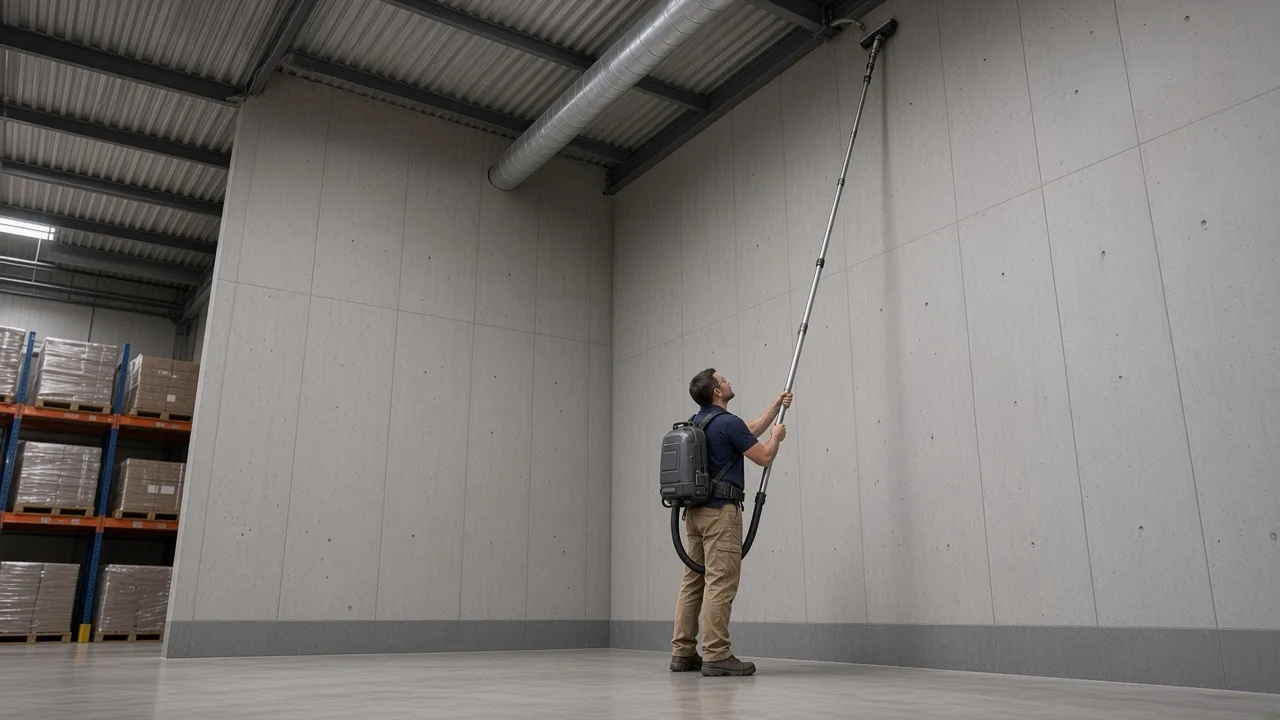
Dust and debris collect where daily cleaning never reaches: rafters, beams, ductwork, light fixtures, and the tops of equipment. What sits up there settles onto product, equipment, and floors below. Renue cleans overhead structures in food production plants, warehouses, and distribution facilities across Oahu with a HEPA-filtered high-reach vacuum system, working from the floor up to 30 feet, with the area below closed off and covered. Every job starts with a walkthrough and a scoped price.
Renue Systems has done this work since 1991 · Licensed and insured · Based in Honolulu, serving facilities across Oahu
What High Dusting Covers
The scope is set at the walkthrough, but this is the overhead work that usually makes it up. If a structure is not on your list, say so when we walk and we will price it in or leave it out, in writing.
- Rafters, trusses, and beams
- Ductwork, exposed tops and sides
- Overhead piping
- Light fixtures
- Ceilings and ceiling decks
- Tops of equipment
How You Know It Is Time
Dust you can see from the floor
Beams, ducts, and fixtures with visible buildup. If you can see it standing on the floor, it has been collecting for a while.
Dust coming down
Debris settling on product, stored goods, equipment, or a floor your crew just cleaned. Overhead dust is usually the source.
An audit or a visit
A USDA inspection, a customer audit, or a corporate visit reads overhead conditions as part of the facility. High dusting is usually scheduled ahead of the date, not after it.
The Work Below Matters as Much as the Work Above
Overhead cleaning is planned from the floor up. Before work starts, we settle what sits below the work, what gets covered, which sections are closed off, and whether the area needs to be down while we are over it. In food plants, that planning is the difference between a deep clean and a contamination problem.
- The area below closed off before work starts
- Equipment and product below covered
- Food-contact surfaces return to your sanitation crew for their final step before production resumes
The Work We Are Set Up For
High dusting is the cleaning of exposed overhead structures, done as periodic or project work with our own crews. The scope is the structure you can see: beams, ducts, pipes, fixtures, and equipment tops.
- Duct interiors and HVAC mechanical work
- Electrical work and bulb replacement
- Nightly plant sanitation contracts
- Tank and confined-space work
Naming it here saves us both a meeting.
How a Job Gets Planned
Walkthrough
We walk the facility with you and look up: the overhead structures, the height and access, and what sits below the work.
Scoped price
You get one scoped price for the work we walked. The price turns on height and access, the amount of overhead structure, the level of buildup, the protection the area below needs, and the work window.
Scheduled window
Overhead work is usually scheduled in a shutdown or overnight window, or in sections that are closed off while you operate. We settle which way at the walkthrough.
Schedule a Walk Through
Tell us what you are seeing overhead and we will set up a time to walk the facility with you. The walkthrough is where the scope and the price come from. Prefer to talk? Call (808) 556-0747.
High Dusting: Common Questions
What is high dusting?
High dusting is the cleaning of overhead structures above normal reach: rafters, trusses, beams, ductwork, overhead piping, light fixtures, and the tops of equipment. It is the part of a facility that daily cleaning never touches, and it is usually done as periodic or project work, not as part of a nightly routine.
Why does overhead dust matter?
What collects overhead does not stay there. Dust and debris settle onto product, stored goods, equipment, and floors, which is why a facility can keep cleaning the floor and never get ahead of it. In food production plants, overhead conditions are also part of what USDA and customer audits look at when they read the state of the facility.
What exactly do you clean overhead?
Rafters, trusses, and beams. Ductwork, on the exposed tops and sides. Overhead piping. Light fixtures, from the outside. Ceilings and ceiling decks. The tops of equipment. Warehouse racking beams and top levels can be added at the walkthrough when they are reachable from the aisle; stored product is not moved by our crew, so if a level has to be cleared to clean it, the facility clears it before the job. The exact list for your facility is written into the scope at the walkthrough, so there is no guessing about what was included.
Do you clean inside ductwork or HVAC systems?
No. We do not clean inside HVAC ductwork. High dusting covers the outside of ductwork and the beams, pipes, and fixtures around it. Duct interior cleaning is a different trade, and it is not part of our scope.
How do you keep dust from falling on our equipment and product?
The area below the work is closed off and covered before we start. The cleaning itself is vacuum based: a HEPA-filtered vacuum pulls dust off the surface as it is cleaned, so the dust is captured instead of brushed loose to settle below. In food plants, food-contact surfaces go back to your sanitation crew for their final step before production resumes.
Can you work while we are operating?
Sometimes, in sections that can be closed off while the rest of the facility runs. Overhead work often goes better in a shutdown or overnight window, especially over production or active storage aisles. At the walkthrough we will tell you which way your job should go.
How high can you reach?
Up to 30 feet from the floor, with our high-reach vacuum system. Above that height, overhead work is only done where the facility approves the use of its lift and the access is safe. If a section cannot be reached either way, we tell you at the walkthrough, before it is priced.
Who provides the lift?
For work above our 30-foot reach, we use the facility's lift, with the facility's approval. That is settled at the walkthrough, before the job is priced, so the price never depends on a lift that has not been confirmed.
How much does high dusting cost in Hawaii?
Every job is quoted as a scope after a walkthrough, so there is no honest per-foot price for overhead work. The price turns on the height and access, the amount of overhead structure, the level of buildup, the protection the area below needs, and the work window. You approve the scope before anything is scheduled.
How often should high dusting be done?
Most warehouses and industrial facilities put it on a semiannual or annual cycle. Food production plants often time it with the periodic deep clean, ahead of audits. The right interval depends on what your operation puts into the air and what your last audit flagged. We can set the cadence at the walkthrough.
How long does a high dusting job take?
It depends on how much overhead structure there is, the access, and how much of the facility we can take at once. Work is planned in sections, and larger facilities are usually done across overnight or shutdown windows. The walkthrough produces a schedule you can plan around, not a guess.
Do you provide documentation we can put in our audit or vendor file?
Yes. You get the written scope before the work, before and after photos of the areas cleaned, and a service record when the job is done. If your vendor file needs a certificate of insurance, we carry general liability and workers' compensation coverage and can send one over. Just ask when you book the walkthrough.
What areas do you serve?
We are based in Honolulu and serve facilities across Oahu.
Ready to Walk Your Facility?
Tell us what you are seeing and we will set up a walkthrough.