
Marble Etching vs. Staining: The Oahu Property Manager’s Guide
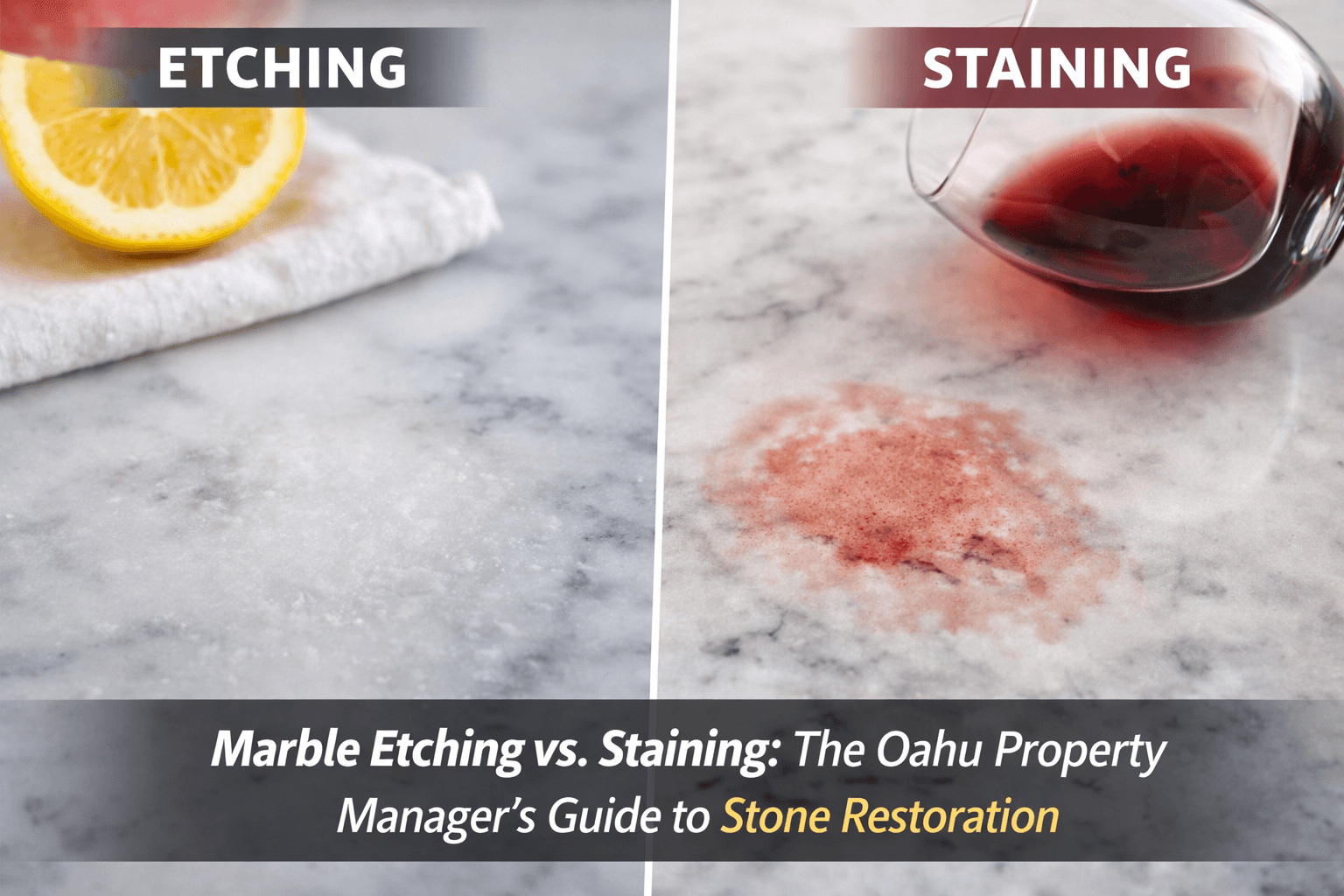
On Oahu, distinguishing between marble etching and staining is the difference between a simple cleaning and a necessary restoration. While a stain is a color change inside the stone, an etch is a chemical “burn” on the surface. At Renue Hawaii, we provide specialized stone restoration and diamond polishing to eliminate etch marks and restore the mirror-like clarity required by 5-star Waikiki resorts and luxury condominiums.
Quick Answer: Is Marble Etched or Stained?
If the mark looks dull, cloudy, rough, or lighter than the surrounding stone, it is usually etching. If the stone is still smooth and polished but the color has changed below the surface, it is usually staining. Etching requires honing or polishing because the surface has been chemically damaged. Staining usually requires poulticing, deep cleaning, or sealing correction.
Identifying the Damage: Is it an Etch or a Stain?
For property managers at high-end Oahu resorts, natural stone vanities and lobby floors are significant capital assets. When a “mark” appears, the instinct is to scrub it. However, if you treat an etch like a stain, you risk deepening the damage. According to the Natural Stone Institute, using acidic cleaners on marble is the leading cause of surface failure.
The Etch: Marble is composed of calcium carbonate, which reacts instantly to acids. When lemon juice, wine, or even certain sunscreens hit the surface, they “eat” the top layer of the stone. This leaves a dull, cloudy spot. If you look at it from an angle, you can often see that the polish is gone. This is physical damage to the stone’s structure.
The Stain: A stain occurs when a substance, like coffee or oil, seeps into the microscopic pores of the marble. The surface remains smooth and polished, but the color has changed underneath. This is pigment contamination.
The “Hawaii Factor”: Hard Water and Mineral Etching
Oahu’s volcanic mineral water adds another layer of complexity. As we discussed in our guide on hard water stain removal, calcium buildup can often hide etching beneath it. When minerals bond to a marble surface, they trap moisture and acids against the stone, leading to “hidden etches” that only become visible after the mineral scale is removed.
The Danger of “Surface Cleaning” in Luxury Suites
Standard janitorial crews often lack the training to handle “Stage 2” stone damage. They may attempt to use “all-purpose” cleaners that contain citric acid or vinegar, the very substances that cause etching. Once a marble surface is etched, it is “open.” The protective seal has been breached, and the stone will now absorb liquids faster than ever before. Professional stone polishing is the only way to “close” the stone and restore its defense system.
The Renue Method: Diamond-Phase Stone Restoration
We don’t use “shines” or topical waxes that yellow over time. We perform a mechanical restoration of the stone itself:
- Grinding & Honing: We use diamond-encrusted pads to “shave” away the etched layer of the stone. This removes the damage and levels the surface.
- Sequential Polishing: We move through progressively finer diamond grits to restore the stone’s natural light-reflectivity. This is how we achieve that “wet look” finish without chemicals.
- Covalent Sealing: Once restored, we apply a professional-grade impregnating sealer. This fills the pores of the marble, providing a “time buffer” for housekeeping to wipe up spills before they become etches or stains.
Financial Strategy: Restoration vs. Replacement
Replacing a marble lobby floor or 50 suite vanities is a multi-million dollar CAPEX event. Restoration with Renue Hawaii typically costs a fraction of replacement costs. By maintaining the “factory finish” through regular polishing cycles, you extend the life of the stone, protecting the property’s valuation and guest experience scores.
Stone Restoration FAQ
What is the difference between marble etching and staining?
Etching is chemical damage to the surface of the marble that creates dull, cloudy, or rough-looking spots. Staining is discoloration caused by liquid absorbing into the stone’s pores. Etching changes the surface finish, while staining changes the color inside the stone.
Can marble etch marks be polished out?
Yes. Marble etch marks can often be removed through professional honing and diamond polishing. The damaged surface layer is mechanically refined, then polished back to the desired finish. Cleaning alone will not remove true etching.
Can you remove water rings from marble?
Yes. Many water rings on marble are actually etch marks caused by minerals, acidic residue, or trapped moisture. Renue Hawaii can assess whether the ring is etching, staining, or mineral buildup, then recommend the correct restoration process.
Can marble be made stain-proof?
No natural stone is completely stain-proof, but professional sealing can make marble more stain-resistant. A quality penetrating sealer helps slow absorption, giving housekeeping or maintenance teams more time to wipe up spills before they become deeper stains.
When should a property manager restore marble instead of cleaning it?
Marble should be restored when the surface stays dull, cloudy, etched, scratched, or uneven after normal cleaning. If the polish is gone or the stone has chemical damage, professional honing, polishing, and sealing are usually needed to reset the surface.
Restore the Luster. Protect the Asset.
Join Oahu’s elite resorts who trust Renue Hawaii for scientific stone restoration.
Spaces, surfaces and service decisions
How the conditions and service decisions connect
These connections summarize the scope or guidance on this page. Follow a concept for its definition and related decisions.
Marblecan be affected byMarble etching
Etching changes marble's surface finish and should be distinguished from discoloration within the stone.
Marblecan be affected byStone staining
A stone stain is a color-change condition; its treatment differs from correction of an etched finish.
Marble etchingmay warrantStone honing and polishing
A true etch may require suitable honing or polishing after the stone and finish are assessed.
Related service, guidance and project accounts