
Glass Restoration · Oahu Resorts & Condos
How to Remove Hard Water Stains from Oahu Resort and Condo Glass
The stage of the buildup, not the strength of the chemical, decides whether the fix is cleaning or restoration.
Oahu’s mineral-rich water leaves deposits on shower glass, lobby glass and exterior windows. Caught early, they dissolve with professional cleaning. Left in place, they bond to the glass until the surface itself needs restoration.
An assessment establishes how much of the cloudiness is removable deposit and how much is surface damage.
Local Conditions
How hard water staining builds on Oahu
As rainwater filters through volcanic basalt rock, it picks up minerals including calcium and magnesium. When this hard water is used in hotel showers or hits exterior windows via irrigation overspray, the water evaporates and leaves a mineral crust behind.
Repeated cycles bond that crust more tightly to glass and other surfaces. Each wet-and-dry cycle adds a layer, which is why a shower door that wiped clean last year can reach a point where wiping changes nothing.
Guest Impact
Why cloudy glass reads as a hygiene problem
Guests do not see mineral buildup when they look at a cloudy shower door. They see a surface that looks unclean. Hard water staining mimics the look of soap scum and film, which is why it draws complaints and poor cleanliness impressions even in a bathroom that was serviced that day.
For Oahu resorts and condos, stain removal is a guest experience issue as much as a maintenance one. A bathroom can be cleaned to standard and still read as dirty until the mineral layer itself is addressed.
The Decision Point
Stage 1 vs. Stage 2: when cleaning becomes restoration
Surface accumulation
This is a top-level deposit. The spots look white and chalky.
- Looks like: white, chalky spots and light crusting.
- Correct response: professional-grade chelating agents used during hard water stain removal can dissolve the mineral bond without mechanical polishing.
Bonded buildup & surface damage
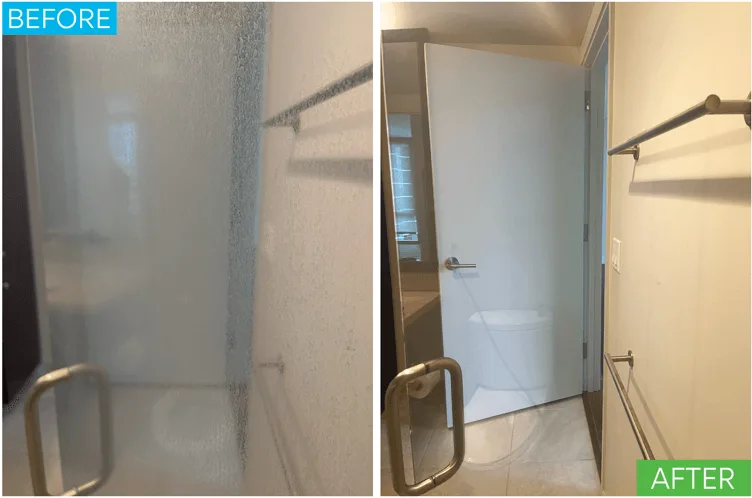
At this stage, deposits have built up over a long period and the glass looks foggy even when wet. Standard chemicals will not correct it.
- Looks like: persistent fog and cloudiness that cleaning does not change.
- Correct response: professional restoration. Mechanical polishing levels the surface and restores transparency.
The wet test separates the stages. If the spots are white and chalky and the glass clears when the deposit is removed, it is Stage 1. If the glass stays foggy even when wet after cleaning, bonded buildup or surface damage is likely, and a restoration assessment is the right next step. An assessment confirms how much of the cloudiness is removable deposit and how much is surface damage, because the two need different scopes.
The Renue Method
Professional glass restoration
-
Non-acidic emulsification
High-performance, non-toxic agents wrap around the mineral ions and lift them out of the surface. This is safe for the surrounding guestroom environment and your staff.
-
Mechanical micro-polishing
For glass with bonded buildup or surface damage, specialized polishing compounds resurface the glass at a microscopic level, reducing the fog and returning clarity.
-
Hydrophobic sealing
Once the glass is clear, a professional-grade hydrophobic sealant helps water bead and roll off instead of sitting and depositing minerals, which slows the return of staining and makes routine housekeeping easier.
The Capital Decision
Restoration vs. replacement
Replacing custom tempered glass means new units, labor, and room downtime. Restoration returns the existing glass to service at a fraction of that disruption, which is why an assessment comes first:
| Glass condition | Correct next step | Why |
|---|---|---|
| Stage 1 deposits | Professional cleaning | The mineral bond can still be dissolved without mechanical polishing. |
| Stage 2 bonded buildup | Professional restoration | Polishing levels the surface and restores transparency; chemicals alone will not correct it. |
| Damage beyond the surface | Replacement | Only glass damaged beyond the surface layer needs new units, labor, and room downtime. |
The related guide on marble etching vs. staining covers the same clean, restore, or replace decision for stone, and our hard water spot removal service covers the full service scope.
Questions
Oahu hard water FAQ
Can Renue Hawaii remove stains from exterior high-rise windows?
Yes. Irrigation overspray is a major cause of exterior hard water damage on Oahu. We provide restorative polishing for lobby glass and accessible exterior windows.
Why do my stains keep coming back after a week?
Without a professional hydrophobic sealer, minerals anchor again the next time the surface gets wet. Sealing after restoration slows that cycle down and makes each routine clean more effective.
Is this safe for my bathroom fixtures?
Yes. Unlike aggressive acidic cleaners found at hardware stores, our process is non-acidic and designed to protect chrome, bronze, and nickel finishes.
How do I know whether my glass is Stage 1 or Stage 2?
If the spots are white and chalky and the glass clears when the deposit is removed, it is Stage 1. If the glass stays foggy even when wet after cleaning, bonded buildup or surface damage is likely and a restoration assessment is the right next step.
Next Step
Request a glass assessment
Call Renue Hawaii on Oahu or request a walkthrough. We will establish which stage your glass is at and scope cleaning, restoration, or replacement accordingly.